Kathryn Kuhlman
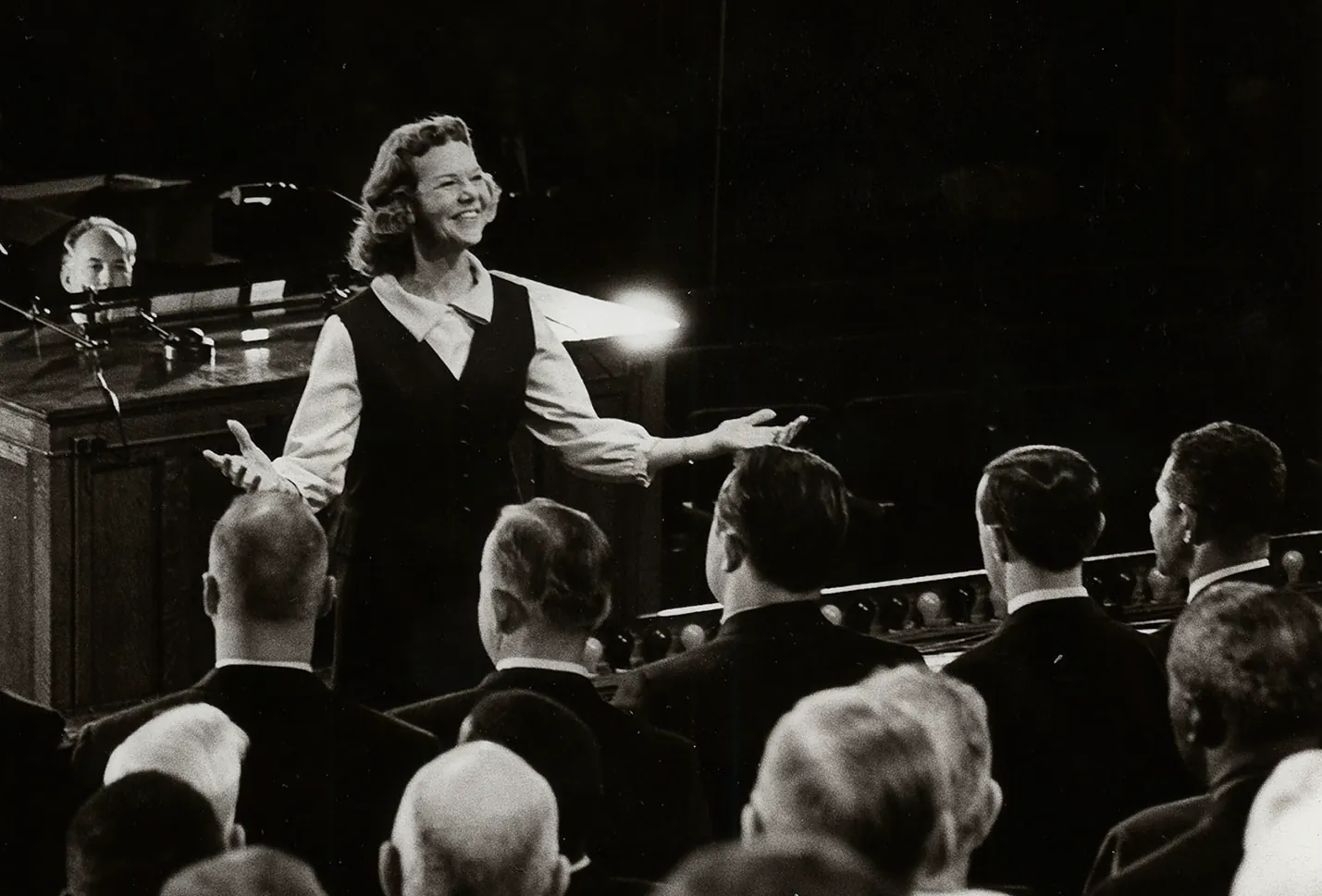
Kathryn Johanna Kuhlman (1907–1976) was an American evangelist whose miracle healing services demonstrated virtually every principle of the Way of Fire—complete surrender, radical obedience, apostolic authority, and the manifestation of miracles as the norm rather than the exception. Her television program "I Believe in Miracles" became the longest-running religious program in CBS history, extending her influence to millions who never attended her services in person.12
The Foundation: Death to Self
The cornerstone of Kuhlman's entire ministry was her understanding that supernatural authority flows only through a vessel that has died to self completely. She made what she called a "pact" with the Holy Spirit:
"All He needs is somebody who will die, and when I died, He came in. I was baptized. I was filled with the Spirit. I spoke in an unknown tongue as He took every part of me. In that moment, I surrendered unto Him all there was of me, everything. Everything. Then, for the first time I realized what it meant to have power."3
The Practice of Daily Dying
This wasn't a one-time conversion experience. Kuhlman institutionalized death to self as a daily, even moment-by-moment practice. Before every service, she would retreat backstage and pace back and forth in prayer for extended periods. Her team understood this was sacred time—they called it "the time when Kathryn Kuhlman dies a thousand deaths."4
She would not emerge until there was "very little of Kathryn left and she was simply a yielded vessel through which the power of God could flow to eradicate disease and demonic oppression."4
This reflects the deepest teaching of the Way of Fire: apostolic authority and miraculous power are inversely proportional to the presence of self.
Radical Obedience and Holy Fear
A defining characteristic of Kuhlman's ministry was her trembling fear of grieving the Holy Spirit. This wasn't neurotic anxiety; it was the biblical fear of the Lord—a reverence so profound that it shaped every decision.
Benny Hinn documented a remarkable scene where Kuhlman became visibly overwhelmed during a service, sobbing with such intensity that the entire auditorium fell silent. When she finally spoke, her words were an anguished plea:
"Please, don't grieve the Holy Spirit. He's all I've got. Don't wound the One I love!"3
Instant Obedience
Kuhlman taught that obedience must be instant and total:
"There is no intimacy without obedience; there is no fire without surrender."5
She insisted that believers develop the habit of saying "yes and step out" before the Holy Spirit even finishes the instruction. This kind of radical responsiveness creates alignment between the believer's will and God's authority, allowing His power to flow without hindrance.
"When you obey the Holy Spirit instantly, the fire will fall."5
The Anointing as Lifestyle
One of the most striking aspects of Kuhlman's life was that the anointing didn't activate only during formal ministry times. Rather, she "carried the mantle as a lifestyle, not as a church event."4
Walking through airports, people would recognize her, ask for prayer, and be immediately slain in the Spirit—some even healed without explicit prayer, simply by her proximity. This is the "Supernatural Normal" that the Way of Fire promises.
Service Manifestations
During her healing services, which often lasted three to five hours, the manifestations were extraordinary. One documented account describes:
"All of a sudden we could hear a wind begin to lightly blow... Whoooosh—the wind hit the wheelchair section, and approximately 30 of those people suddenly jumped up and walked out of their wheelchairs!"4
Another witness reported:
"Someone would get healed—and then boom, boom, boom! Healings started popping like popcorn all over the auditorium."4
Sovereign Healing
What distinguished Kuhlman from other healing evangelists was her understanding that these manifestations weren't the product of her faith or her prayers, but rather the sovereign, overwhelming presence of the Holy Spirit.
She realized that "simply by honoring the Holy Spirit and by being in God's presence, healing could be released." People were healed:3
- Without prayer cards
- Without personal ministry
- Without her even touching them
- Some healed simply sitting quietly in the audience
The Authority She Claimed—and Rejected
Kuhlman's stance on personal credit stands in stark contrast to much of modern Christianity. She adamantly denied having a gift of healing:
"I would never say that I have ever received any gift. The greatest of the Christian graces is humility. All I know is that I have yielded my body to Him to be filled with the Holy Spirit, and anything that the Holy Spirit has given me, any results there might be in this life of mine, is not Kathryn Kuhlman. It's the Holy Spirit; it's what the Holy Spirit does through a yielded vessel."3
Yet she claimed absolute authority over demons, disease, and death. The paradox of the Way of Fire is that one must claim no authority over one's own will while simultaneously exercising complete authority over the kingdom of darkness.
Rejection of Showmanship
Kuhlman refused to use the tactics of her contemporaries:3
- No prayer cards
- No healing lines that might suggest human orchestration
- No dramatic exhortations to "have faith" that might imply the healer's personality was a factor
Instead, she created an environment of worship and waited on the Holy Spirit's sovereign movement.
Six Habits for Carrying the Fire
Kuhlman's teaching on how to maintain intimacy with the Holy Spirit emphasized six core spiritual habits:5
1. Surrendered Prayer from First Light
Beginning the day not with self-directed activity but with surrendered prayer:
"Holy Spirit, I love you. I need you today. Walk with me."5
2. Word Feeding with the Spirit's Help
Not merely reading Scripture, but:
"Letting it sink into your spirit until it becomes a part of who you are. Until it burns in you, until it speaks louder than your fears, louder than your doubts."5
3. Daily Communion with the Holy Spirit
Constant, sincere prayer creating ongoing conversation rather than formal petition.
4. Instant Obedience to His Voice
The moment you sense His direction, you move—no hesitation, no second-guessing.
5. Sensitivity to His Whisper
Developing the spiritual capacity to hear the still, small voice amid life's noise.
6. Holy Expectation
"Wait on God like a lover waits for a whisper in the dark. Learn to sit with him with no agenda, no pressure, no rush, just love, just longing, just faith."5
Simple, Absolute Faith
Kuhlman was known for her simple declarations of faith. She would often just whisper:
"I believe God."
That simple confession carried tremendous power. As referenced in The Power of Declaration:
"And tumors would dissolve. The deaf would hear. The blind would see. Because she wasn't hoping. She was believing. And she was speaking what she believed."
Faith Defined
Kuhlman described faith as:
"Faith is that quality or power by which the things promised in the Word of God become reality."
This aligns with the Way of Fire understanding of truth vs facts—speaking God's promises until they manifest.
The Price of the Fire
Kuhlman paid an extraordinary personal price for the authority she carried. She made a conscious decision to "lay on the altar her desire for a husband and children in order to fulfill the call of God."4
She also faced:
- Opposition from religious institutions
- Skeptical media coverage
- A society that viewed female preachers with suspicion
- Lawsuits and public questioning of her integrity in her final years
Yet she never wavered in her commitment to the Holy Spirit. Had she grieved Him, she would have "never again walked out on a stage." The relationship with the Holy Spirit was worth more than vindication, financial security, or personal reputation.45
Generational Influence
Kuhlman's ministry shaped the next generation of Spirit-filled ministers. When Benny Hinn encountered her ministry as a young man, it "ignited an undying hunger" that shaped his entire calling.3
She became known as a "plumb line"—a voice calling the church back to purity, surrender, and radical devotion to God. Her message was simple:
"Die today—die to self, let go of idols, and come to the place of life, of deep surrender."4
The response was visceral: "People came to the front weeping and wailing in repentance as they encountered His love and the weight of His presence."4
Why Kuhlman Matters Today
Kuhlman's life speaks directly to the central thesis of the Way of Fire: that ordinary people, when they surrender completely and obey radically, can walk in the same supernatural authority Jesus promised His disciples.
She had no advanced theological education—she dropped out of high school at fourteen. She had no natural charisma or showmanship skills. She was a woman in an era when female preachers faced institutional and social opposition.
Yet through complete death to self, daily maintenance of intimacy with the Holy Spirit, and radical obedience to His voice, she became one of the most powerful healing ministers of the twentieth century. And she did it in such a way that even her critics could not deny the reality of the miracles.
"This is the Way of Fire that Kuhlman exemplified: not the fire of human ambition or institutional authority, but the fire of heaven—consuming, purifying, overwhelming in its power, and accessible to any believer willing to pay the price of surrender."
Related
- Smith Wigglesworth
- John G. Lake
- William Seymour
- Kenneth Hagin
- The Way of Fire
- The Fire
- Holy Spirit
- Miracles
- Healing
- Obedience