Aimee Semple McPherson
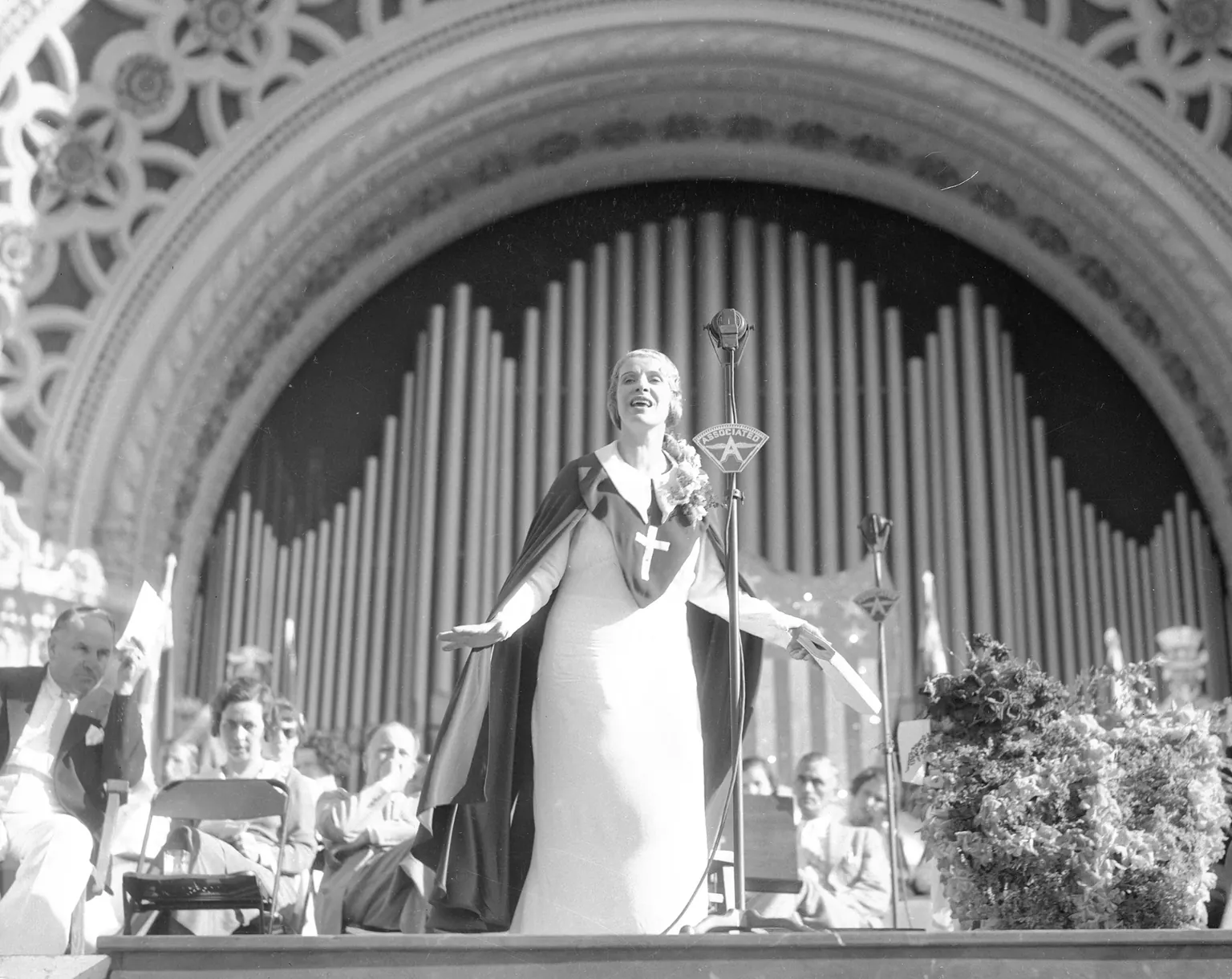
Aimee Semple McPherson (1890–1944) represents one of the most remarkable expressions of the Way of Fire documented in modern history. Her 26-year public ministry demonstrated the Way of Fire operating through unprecedented institutional scale, cultural barrier-breaking, and media innovation—yet grounded in identical foundational principles: complete obedience, Holy Spirit baptism with fire, and supernatural authority flowing through daily consecration.12
She founded the International Church of the Foursquare Gospel, built the Angelus Temple in Los Angeles, pioneered radio evangelism, and saw over 250,000 documented healings across her ministry.
The Foundation: Holy Spirit Baptism with Fire
McPherson's spiritual journey began with radical hunger for the Holy Spirit. In 1908, at age 18, she locked herself in prayer, refusing to eat until God baptized her in the Holy Spirit. Her own testimony reveals the intensity of her pursuit:
"I kneeled down...determined in heart...I will not eat another meal until you baptize me."3
After hours of earnest prayer, the Holy Spirit came upon her with undeniable power. She spoke in tongues for the first time, describing it as "rivers of praise in other tongues" that the Spirit gave her.
The Foursquare Gospel Revelation
This wasn't an isolated experience but the foundation that shaped her entire theology and ministry. The revelation of the Foursquare Gospel—which became the doctrinal center of her church—came from meditating on Ezekiel's vision while filled with the Holy Spirit.4
She understood Jesus Christ in four aspects:
- Savior (Romans 6:23)
- Baptizer with the Holy Spirit (Acts 1:5)
- Healer (Matthew 8:17)
- Coming King (1 Thessalonians 4:16-18)
This theology of the baptism with fire became mandatory for all who would minister in her movement. She established that the Holy Spirit's baptism was not an optional supplemental experience but essential equipment for Kingdom authority.4
Radical Obedience Against Cultural Boundaries
Where McPherson's obedience becomes strikingly visible is her willingness to break cultural barriers no one else had broken.
Breaking Every Convention
In 1915, as a woman, she left her failing marriage to pursue evangelism—at a time when women did not preach. This was not a minor social transgression; it was cultural suicide. She then did something unprecedented: she drove a car across America alone with her two children, living in tents, preaching from tent meetings with nothing but a car and faith.1
She responded to God's voice over every competing obligation. In 1915, after a miraculous healing from a supposed terminal condition, she heard God say, "Go preach," and she obeyed immediately, leaving her husband a note inviting him to join her work instead.5
Faith-Based Building
By 1923, she had raised $250,000 to build the Angelus Temple in Los Angeles—a 5,300-seat facility with a 125-foot dome (the largest in North America at the time) and completely debt-free. She did this through decades of tent revivals, cross-country tours, and faithful donors who believed in her vision.6
Supernatural Healing Authority
McPherson's healing ministry operated at extraordinary scale. Over 250,000 documented healings occurred across her 26 years of public ministry, with independent verification through medical professionals and church surveys.17
First Public Healing
Her first public healing (1916) involved Louise Messnick, a young woman with severe rheumatoid arthritis who required crutches even to walk. When McPherson laid hands on her head and prayed, Messnick felt "a warm surge of energy" and left the meeting walking upright without crutches.7
Scale of Ministry
The scale of demand for her healing ministry exploded:
- 1921 in San Diego's Balboa Park: 30,000 people rushed the stage for prayer, requiring police and U.S. Marines to maintain order
- 1921 San Jose First Baptist Church survey of 2,500 attendees found:
- 6% reported immediate and complete healing
- 85% reported partial healing that continued improving
- Fewer than 0.5% reported no spiritual benefit
- The American Medical Association itself verified in 1921 that many of her healings had indeed occurred17
Humility in Healing
Yet McPherson understood herself as the conduit, not the source. She explicitly rejected being given credit for healings, viewing them as sacred gifts from God flowing through her. This humility is crucial to the Way of Fire: it prevents personal ambition from poisoning the pipeline of God's power.
Daily Spiritual Disciplines
The Way of Fire requires more than momentary power experiences. It demands daily consecration. McPherson embedded this into the institutional structure of Angelus Temple.
24-Hour Prayer Tower
She established a 24-hour Prayer Tower where prayer never ceased—men gathered in two-hour prayer shifts during the night, women during the day, bringing before God thousands of requests from mail, telephone, and telegraph from around the world.8
Fasting and Consecration
She herself practiced extended seasons of fasting and prayer. In her teachings and writings, she emphasized spiritual disciplines rooted in Wesley's tradition and the Pentecostal values of her upbringing:
"Spiritual disciplines like fasting, and silent 'waiting on God.'"4
This wasn't legalistic abstinence but power preparation. She understood that fasting breaks the flesh's rule, allowing the Holy Spirit to dominate the human will.
Holy Desperation
McPherson's prayer for the Holy Spirit baptism, quoted in Chapter 4: What Is Fire?, exemplifies the desperation required to access the fire of God:
"Oh, Lord, I am so hungry for your Holy Spirit. You have told me that in the day when I seek with my whole heart you will be found of me. Now, Lord, I am going to stay right here until you pour out upon me the promise of the Holy Spirit for whom you commanded me to tarry, if I die of starvation. I am so hungry for Him I can't wait another day. I will not eat another meal until you baptize me."3
That's the kind of desperation that accesses the fire.
The Standard for Seeking
McPherson's prayer sets the standard for how to pursue Holy Spirit baptism:
- Whole-hearted seeking
- Refusal to give up
- Willingness to sacrifice everything
- Desperation that won't be denied
This contrasts with casual, comfortable Christianity that never experiences the supernatural.
Training Others: L.I.F.E. Bible College
Where John G. Lake trained Divine Healing Technicians to multiply healing ministry, McPherson established something even more comprehensive: L.I.F.E. Bible College (Lighthouse of International Foursquare Evangelism).8
Founded in February 1923, just weeks after Angelus Temple opened, it immediately proved too small. Within a few years, a 5-1/2-story college building had to be constructed adjacent to the church.
Women in Ministry
More significantly, she established precedent for women in ministry. In a time when female preachers were culturally ostracized, she trained women to pastor churches, teach Bible, and exercise spiritual authority equally with men. Her Foursquare Church theological statement explicitly declares that spiritual experience and preparation for service qualifies for ministry "regardless of gender, age, or ethnicity."9
L.I.F.E. Bible College still operates today as Life Pacific University, having trained thousands of ministers.
Building the First American Megachurch
McPherson understood something about the Way of Fire that's often missed: it doesn't operate only through lone prophets or traveling evangelists. It requires institutional infrastructure.
Angelus Temple
The Angelus Temple, opened January 1, 1923, was not just a church building—it was a comprehensive social, spiritual, and humanitarian center:610
- A sanctuary seating 5,300 (attended by 10,000+ weekly during her lifetime)
- A 24-hour Prayer Tower with continuous intercession
- A Bible Training School (L.I.F.E. College)
- A soup kitchen (1936, serving thousands during Great Depression)
- An employment bureau
- A commissary for food distribution
- A parole committee serving formerly incarcerated people
- Hospital visitation committees
- A home for wayward girls
- An orphanage
This was the Way of Fire embodied in institutional form. She didn't just preach about Kingdom values; she built systems to live them out.
Community Transformation: Great Depression Ministry
The ultimate proof of the Way of Fire is not sensational miracles but sustained love for the community.
1.5 Million Meals
During the Great Depression, the Angelus Temple commissary distributed over 1.5 million meals to hungry people in Los Angeles. She didn't limit ministry to the wealthy or the educated.16
The Romani people—historically unreached by American Christianity—came to her meetings and experienced healing. Grateful for miracles, many donated gold jewelry and necklaces, which McPherson used to help fund the temple's expansion and humanitarian work.1
Her nickname was "Everybody's Sister"—not because of marketing but because she actually related to people across class, race, and background with genuine compassion.
Media Innovation
McPherson pioneered broadcast evangelism at unprecedented scale:116
- Founded KFSG radio station in 1924
- Eventually had meetings broadcast on 45 different radio stations
- One 150-day tour involved 15,000 miles of travel, 336 sermons delivered, reaching over 2 million people in person, with millions more via radio
She understood that the Way of Fire in her era meant using every available technology to spread the Gospel. She incorporated dramatic arts into her sermons, using colored illustrations, staged set pieces, and theatrical presentation to make complex theology accessible to ordinary people.
The Humility Factor
Late in her ministry, McPherson made a remarkable decision. As the healing demonstrations grew overwhelming (with thousands rushing the stage), she began stepping back from the public healing ministry, instead training others to continue the work.7
When asked about her healing demonstrations, McPherson replied:
"The saving of souls is the most important part of my ministry."1
She refused to let miracles become entertainment. She viewed each healing as a sacred gift from God, not as a platform for personal glory.
Why McPherson Matters Today
Aimee Semple McPherson demonstrated that the Way of Fire:
- Can flow through women in full apostolic authority
- Can operate at massive scale without losing spiritual integrity
- Can build institutions that outlast the founder (100+ years)
- Can reach millions through media while maintaining authenticity
- Can serve the poor while moving in supernatural power
- Can break cultural barriers while maintaining theological orthodoxy
Most critically, McPherson proved that sustained supernatural power requires sustained spiritual discipline. Her 24-hour prayer tower, her fasting seasons, her scriptural meditation, her daily consecration—these weren't optional religious exercises. They were the infrastructure that allowed 250,000 documented healings to flow through one woman's ministry without corruption.
"The age of miracles has not passed. When believers walk in the Way of Fire as McPherson did—with radical obedience, Holy Spirit baptism, daily spiritual disciplines, prophetic revelation grounded in Scripture, institutional vision, community love, and refusal of lukewarm religion—the Book of Acts continues."
Related
- William Seymour
- Kathryn Kuhlman
- John G. Lake
- Smith Wigglesworth
- The Holy Spirit
- The Fire
- Healing
- Miracles
- Chapter 4: What Is Fire?