Chapter 9: Money and Recompense
Written by Gary, carrying Apostle Delmar's teaching from our 2026-07-07 conversation.
Almost everyone I know works out of fear.
Not the lazy ones. The diligent ones. Believers included. They grind to the edge of burnout because underneath the ambition is a quiet terror: if I let up for one second, I will get fired, go broke, end up on the street. I told Apostle Delmar this, because I see it everywhere, and I wanted to know how a man who has walked in provision for four decades thinks about money. His first answer went straight to the fear.
"We don't do fear," he said, "because fear is a spirit. It's impossible to be in faith and fear at the same time." Chapter 8 put a name to that. Fear is the tell that your hand has crept back onto the wheel. Nowhere does that hand grip harder than around money. So this chapter is the specific application of Obedient Flow to the one thing people toil for most. The claim is simple and it runs against almost everything the world teaches: provision comes to the obedient, not to the anxious. You do not seize money by striving harder. You receive it by staying in step with the God who already promised to feed you.
Provision Is Received, Not Seized
There are two ways to get money wrong, and they look like opposites.
The first is the striver's way. Grab the wheel, force the outcome, work past the point God asked for, because the whole weight of your survival feels like it rests on your effort. That is fear wearing the mask of diligence, and Chapter 8 already named it as toil.
The second looks spiritual and is just as off. It is the name-it-and-claim-it reflex, where a believer picks a number God never gave him and tries to command it into his account by sheer confession. That is grabbing the wheel too, in worship clothes. Delmar is emphatic that faith needs a word first. "Faith only comes when you have a word from God, when it's crystal clear that God said this." A declaration with no word behind it is just wishing with volume.
The obedient way sits between them. You do the work God assigned, in the light you have, and you trust Him for the increase you cannot manufacture. Provision is a thing you receive with an open hand, the same way you receive a miracle or healing. The striver and the name-it-claim-it believer are both trying to be the source. The obedient believer knows who the source is, and stays close to Him.
Tithing Is a Covenant of Salt
Here Delmar said something that reorganized how I think about giving.
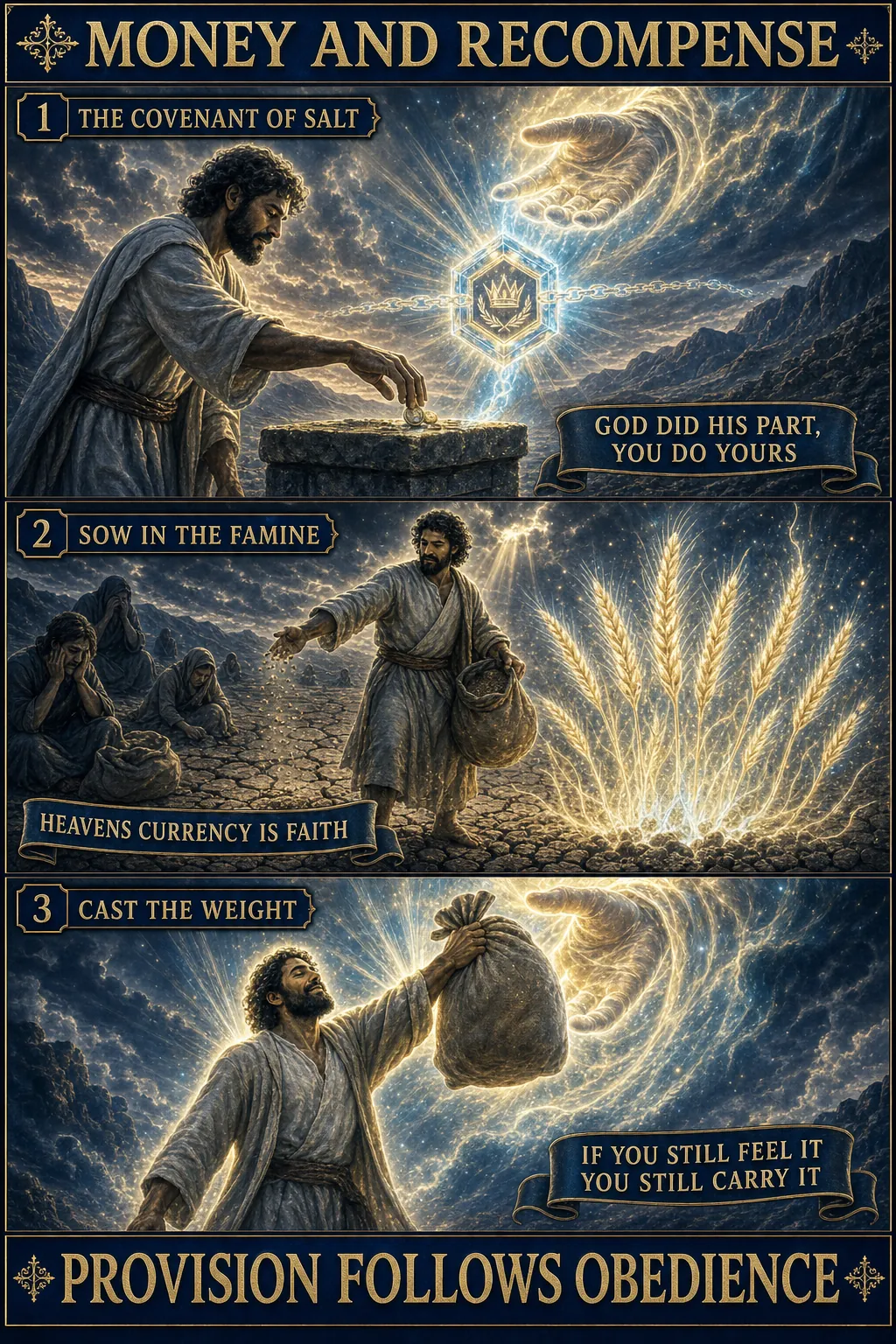
Most of us treat the tithe as a good deed we hope God notices, or a bill we pay when the month allows. He calls it a covenant, and he does not soften the word. "Tithing is a covenant of salt. A covenant of salt can never be dissolved. You can't fast for it, you can't pray for it. It's a covenant. God already did His part, you do your part, and nothing can stop the money from coming in."
Sit with the logic, because it is freeing once it lands. A covenant is a settled arrangement with the terms already fixed. God has done His side. The only variable left is whether you do yours. So the tithe is not a lever you pull to get God to move. It is the one place where the outcome is already guaranteed and the only thing that can break it is your own hand.
Delmar puts the warning just as plainly. If you withhold it, "you're taking money out of your own pocket and disqualifying yourself from the blessing." That is not God punishing a late payment. It is a man stepping outside the one covenant that was working in his favor and then wondering why the provision dried up. "Will a man rob God? Yet ye have robbed me... in tithes and offerings" (Malachi 3:8, KJV). The obedience here is unglamorous and mechanical, which is exactly why it is a good test. You give the first tenth before you know whether the rest will stretch. And it stretches.
Faith Is Heaven's Currency
When you are afraid about money, the fear feels concrete because it is counted in dollars. Delmar reframes the whole ledger.
"These people don't want to take faith for your bills, they want currency. But the ekklesia, that's heaven's currency." Earth runs on one kind of money. Heaven runs on another, and the exchange rate is set by God, not by your bank. Faith is the currency that moves things in the realm where your provision originates. That is why a believer can send a gift with no income in sight and be making a shrewd investment, because he is spending heaven's currency in heaven's economy.
This is the same truth the machine age chapter reaches from the other side. Money is permission to execute your will in the world. Heaven has its own permission system, and it is denominated in obedience and faith. The believer who learns to trade in that currency is never poor, because he has access to the treasury that funds the visible one.
Sow in the Famine
The proof of which economy you trust shows up when things get lean.
Delmar keeps returning to Isaac. "Then Isaac sowed in that land, and received in the same year an hundredfold: and the LORD blessed him" (Genesis 26:12, KJV). Isaac planted during a famine, when every natural instinct said hoard the seed and eat it. He sowed it instead, and reaped a hundredfold in the same season everyone else went hungry. Sowing in the famine is the acted-out form of trusting heaven's currency over earth's. It only makes sense if you believe God is the source and the drought is not the final word.
Delmar has lived it in ordinary terms too. He needed a raise. The company told him they only gave three percent. He decided he needed closer to fourteen, and here is what he did while he waited: "I started paying my tithes as if I was already getting the 13, 14 percent raise. It wasn't long before I got exactly what I was looking for, and it blew my manager's mind." That is not a manipulation trick. It is obedience running ahead of the evidence. He acted on the provision before it arrived, because he trusted the covenant more than the payroll department. The seed went into the ground in the famine, and the harvest came.
Cast the Weight, Then Work
None of this means you stop working. It means you stop carrying.
"Casting all your care upon him; for he careth for you" (1 Peter 5:7, KJV). Delmar gave me the sharpest test I know for whether you have done it. "If you feel the weight of it, that means you still got it. You're still carrying it. Until I cast it off, this ain't going to be pretty." The weight of money worry is not a feeling to push through. It is a readout. As long as you can feel it, the sack is still on your shoulders, and no amount of extra hustle will lift it, because hustle is not what puts it down. Handing it back is.
So the daily practice is the one from Chapter 8, aimed at your finances. You do the next obedient thing with your money, the tithe, the honest work, the seed God told you to sow, and you deliberately hand the outcome back to Him. Then you work from light shoulders. A believer with his care cast on Christ out-produces the one grinding under the weight, because he is not spending half his strength holding up a sky that was never his to hold.
Recompense Is God's Justice
There is a harder edge to provision, and it is worth naming so no one reads this chapter as a formula for getting comfortable.
Recompense is God repaying what the enemy stole. "I will restore to you the years that the locust hath eaten" (Joel 2:25, KJV). It is real, and Delmar has seen it come. But it is God's justice on God's timing, and it is aimed at His purposes, not at your lifestyle. The danger is turning a promise of restoration into a wealth technique, treating God like a machine that pays out when you insert the right confession. Keep it honest. You obey, you sow, you cast the care, and you leave the size and the schedule of the recompense in the hands that keep the ledger. What He restores, He restores so you can carry more fire, not so you can finally relax into comfort.
That is why Jesus let the rich young ruler walk away. "Sell whatsoever thou hast... and come, take up the cross, and follow me" (Mark 10:21, KJV). Jesus was not after the man's money. He was after his heart, and the money was the thing the man had put in front of it. Delmar said it flat: "Jesus didn't want his money, He wanted his heart." The increase was on offer, a hundredfold of it, and the price was one act of obedience the man would not pay. Every provision in this book sits behind a door like that. The question underneath the money is always the same one this whole book keeps asking. What has God told you to do, and will you do it?
Don't Idolize Your Suffering
There is one more thing that will hold back the recompense, and it hides inside the very wound God wants to repay.
The injustices done to you are not your fault. Name that plainly, because too many believers carry false guilt for what was done to them. But there is a part that does become your responsibility, and Delmar names it without flinching. Continually harping on the injustice, rehearsing it, building your identity around it, making an idol of your own suffering, that part is on you. A man can get so used to the wound that he starts to feel like a general in his suffering. He wears it like rank. He can even become addicted to the pain, because the pain has become the thing that makes him feel significant. And that idol is heavy enough to hold back the very recompense God is bringing.
Understand why God wants to repay you in the first place. It is not because your pain earned it. It is because you are a king's kid, and a king does not let His children be robbed without an answer.
"For we know him that hath said, Vengeance belongeth unto me, I will recompense, saith the Lord." (Hebrews 10:30, KJV)
"To me belongeth vengeance, and recompence." (Deuteronomy 32:35, KJV)
"And I will restore to you the years that the locust hath eaten." (Joel 2:25, KJV)
That is the Father's heart toward what was stolen from you. The enemy engineered it, situation after situation, through money and through relationships, first to hurt you and then to take advantage of the hurt. He wounds you, and then he sells you the idol of the wound, because as long as you are worshiping your own suffering you will never lift your eyes to the One bringing the recompense. Naming the idol breaks it. Call it what it is, set it down, and stop feeding it. Then the doors open, and the blessing that was backed up behind the offense comes in.
The Chapter in One Line
Money is received by the obedient, tithed by covenant, denominated in faith, sown in the famine, and worked for with the care already cast on Christ, so provision follows obedience and never the other way around.
Stop chasing the money and obey the God who owns it. Do your part of the covenant, cast the weight back, and let the increase find you doing what He said.